An Inside Look at Ukraine
“A bigger revival is coming,” Peter Dudnik, a pastor in eastern Ukraine, said in an article published by Every Home in late 2018.
Dudnik was working closely with Every Home to carry Christ amid the complex political and religious divides shaping his nation. He and other Ukrainian believers looked forward to the future, encouraged by growing acceptance of the evangelical church.
Then, in February 2022, Russia attacked.
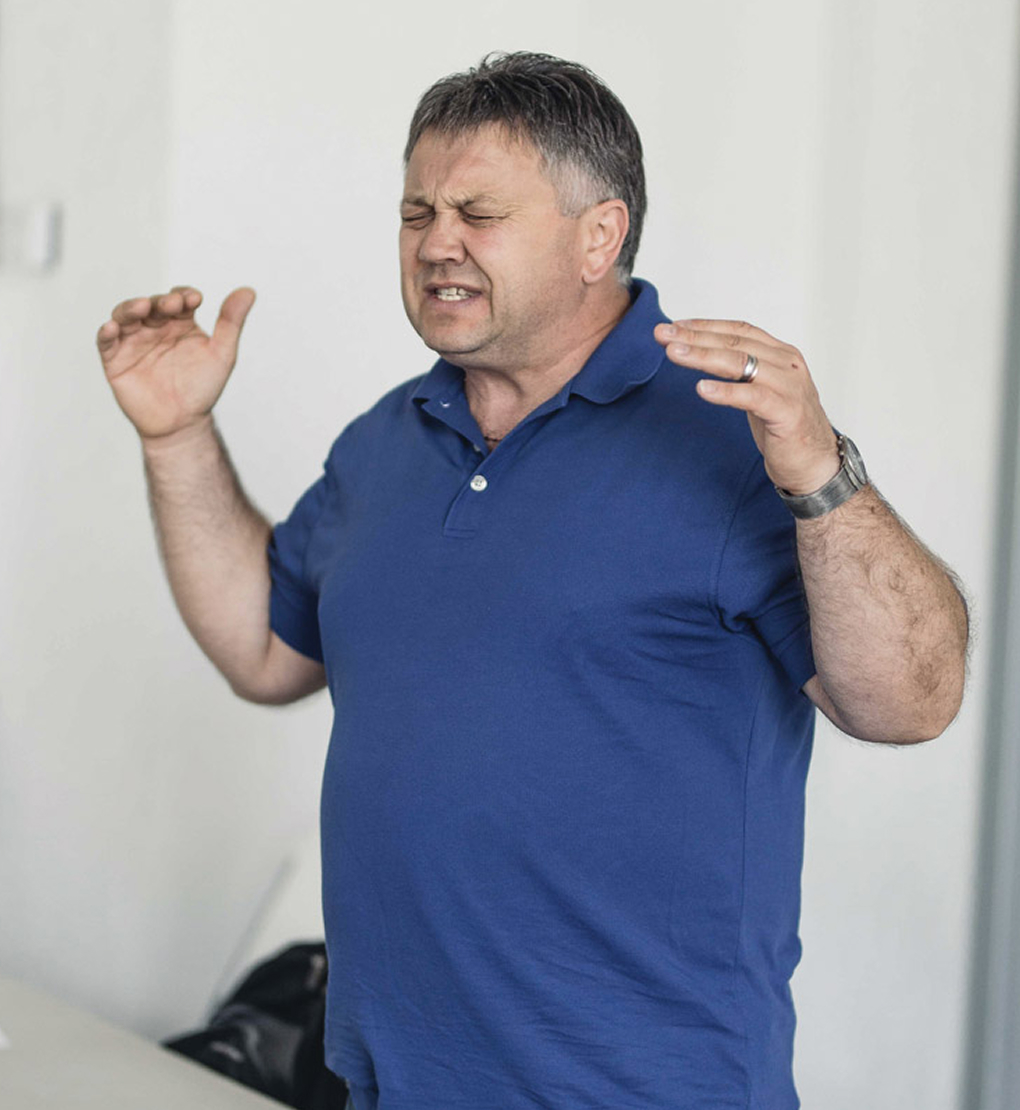
Peter Dudnik prays over his nation during a meeting with Every Home leadership.

A Light in the Crisis—The Christian Response
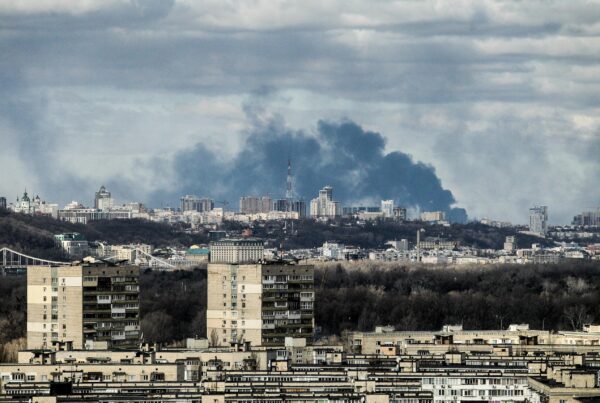
The world watched, shocked and heartbroken, as images of bombed-out apartment buildings and abandoned family cars, riddled with bullet holes, filled newsfeeds.
Jaroslaw Lukasik, who began serving with Every Home a few years into the war and leads one of two national offices in Urkaine, reflects: “The war is a concentration of evil—selfishness, aggression, pride, and every sin. So, therefore, it’s a very intensive spiritual situation, which changes everything. But, besides this, the war is an open window for the gospel. People feel the fragility of life. And Christianity is the message for times of crisis.”
Every Home’s network immediately leapt into action, coordinating churches and believers in Romania, Poland, Slovakia, and Bulgaria to receive refugees, minister to soldiers, and bring relief to the war zone. Every Home’s partners gave generously to meet emergency needs. In many cases, Every Home responded faster and more efficiently even than governments and aid groups.
Pavel Valkov, Every Home Area Director for the Balkans, who helped coordinate crisis response throughout his region, recalls: “The first people who met the refugees at the border were Christians. They were there to show them [the refugees], ‘Look, there is a church. You can stay there. You can eat. They will help you.’”
Churches transformed into shelters. Believers volunteered their time to help refugees find jobs, childcare, and long-term living arrangements.
Often, the response exceeded even the need. “You would make a post on Facebook asking for spare mattresses, and then we would have to stop [people] because we had more than we needed,” says Stefan Vudjik, Every Home Area Director for Western Europe.
“The response of regular people and Christians was something that I would never have expected,” Stefan says.
Help equip the Church in Eurasia to continue shining as a beacon of hope.
Believers Opened Their Homes
Pavel and his family, who live in Bulgaria, were among those who opened their home to a refugee family.
“They were Orthodox. We couldn’t tell them much about God, so we showed love,” Pavel says. After the family moved to Ireland, they stayed in touch with Pavel and his family. One day, they reached out to Pavel’s wife, Monica, asking for prayer; the woman’s brother had just been killed in action.
“You know, these people, they will never forget the life and the faith we were living,” Pavel reflects. “So, in these [tragic] moments they are coming back because they know that there is someone who can pray, support, and help.”
This relationship, reaching across faith traditions, backgrounds, and nationalities, has deeply impacted Pavel.
Zuzanna Marfoldiova, who serves as Every Home’s Eurasia Operations Director, also opened her home in Slovakia.
She recalls how the experience changed her and how the believers are still serving, over four years later, long after media attention faded.
“I think the people who are still involved are the people who have opened their hearts, their homes, for people,” she says. “They have been personally involved with the stories of the people who’ve been impacted by the war. And through them, you see how much pain and brokenness there still is, and you have empathy for them. They’re not those strangers out there. For example, we have a family who have stayed with us. We are still in touch with them. They are our people. And when they are your people, then it’s your story.”
Stefan and Pavel have both observed that working together to respond to the crisis has deeply shaped the Church throughout Europe.
“Almost every church now in Slovakia has some Ukrainian people,” Stefan observes. “It helped us to start looking farther than just our backyard. It called [the Church] to our roots and to loving our neighbors more.”
This awakening of empathy, Stefan says, has extended into the wider society. In places where foreigners were once viewed with suspicion or even hatred, people now felt compassion for the plight of those forced to flee their homeland. Many were, perhaps, also inspired as they witnessed the Church lead the charge.
“The Church has grown in its credibility,” Pavel shares, “now that [people] see the Church visible in society, helping, showing love and compassion.”
Every Home’s international network was uniquely placed to effectively respond to the crisis, and our offices across Europe found new ways to collaborate.
Stefan notes, “[The war] melded us more together. We shared more information, projects, and especially outreach materials…and it’s still going on.”

The Spark of a Long-Awaited Revival
In Ukraine, historically fractured by significant divides between denominations and traditions, this spirit of collaboration has also taken root.
Jaroslaw joyfully paints a picture of the diverse believers who are faithfully carrying Christ to their neighbors in Ukraine today:
“They are all very different people, mostly young people. I think 70 percent are people below 30. I love working with young people. Among them are Polish, like my family, or [from other nations], but most of them are Ukrainians from different regions.”
And then there is Every Home Ukraine’s vast network of ministry partners. “They are many,” Jaroslaw says. “It’s hard to even number them because God has blessed us.”
Jaroslaw and his team have established partnerships with humanitarian aid ministries, the youth ministries of every main Protestant denomination in Ukraine, and several major chaplain associations, equipping believers as they minister on the front line.
And Jaroslaw is excited to share that he and his Every Home team are the “architects of the All Christian Movement in Ukraine”—an initiative to encourage collaboration between every Christian tradition.
“We are preparing to host a forum which unites every confession in Ukraine,” Jaroslaw shares. “Heads of confessions will gather with activists that are focused on evangelism in different spheres of society. It’s not easy, but I believe everything will happen by the grace of God.”
Jaroslaw hopes to build on ecumenical relationships born out of necessity during the war.
Faced with the tremendous need for comfort and support in their communities, Catholic and Orthodox leaders and congregations have begun to utilize outreach and prayer materials from Every Home.
These Scripture-grounded resources offer answers to people who, witnessing the love of Christ in the Church’s crisis response, are bringing their burdens and questions to the nearest church. The divisions between traditions now seem less important.
This collaboration is bearing fruit. Jaroslaw relates a story of a man living near the front lines who was considering taking his own life when he came to an Orthodox church. The man had “lost the meaning of life,” Jaroslaw says. The Orthodox church he visited happened to be one that receives literature from Every Home.
“He took this book,” Jaroslaw says, “and started to read the prayers and quotations from the Bible.”
The man read the literature over and over for many days. Then, he started to attend Church services and is now a member.
“I believe in the unity of the Church in the mission of the gospel,” Jaroslaw says. “Evangelism will be successful when the Church is united.”
Your gift supports partnerships with churches throughout Eurasia, fueling unity, collaboration, and creativity.
Jaroslaw’s own testimony is one of the reasons for his passion and conviction.
“I was Catholic for half of my life,” he shares. “Some evangelicals from Campus Crusade for Christ in 1978 decided to work with Polish Catholics and trained one very gifted priest. He created a Catholic movement with very evangelical spirituality. And I was spiritually born there. So, I want to repeat this for Ukraine. I understand them. I can talk with them in the same language.”
As with the cross-cultural bonds that have formed between Ukrainian refugees and believers who opened their homes to them, a shared story as the power to foster empathy, dissolve divides, and spark collaboration that gives birth to revival.

The Gospel for War Conditions
Jaroslaw envisions partnerships that will spark creativity and the development of new outreach strategies, all for the sake of Christ’s love moving farther and more swiftly.
“The war has opened the hearts of people for Christian hope,” Jaroslaw says. “But we need a specific type of evangelism, a gospel for war conditions.” He notes the high demand for resources about prayer and counseling. Ukrainians are seeking “the gospel that responds to the people’s questions, requests, needs, and feelings,” he explains.
In some ways, the conflict may be an unexpected catalyst for the revival Ukrainian believers hoped for in 2018. The dream feels within reach, not only in Ukraine but in the surrounding nations of Europe, where the Church has a precious opportunity for continuing witness. People are watching and perhaps asking, “Who are these people who take in strangers and have peace amid danger, and whose message do they carry?”
Jaroslaw carries two important aspects of God’s character through his ministry—a message he sees as critically important in the context of ongoing war.
“I am seeing God during the war in two aspects of his character. He is the Lord of history. He is the Lord of all the structures, all regimes, of everyone. [And also] he is in people. He is with them, with their fears, hopelessness, and suffering. He understands every old woman, every kid who lost parents.”
The empathy and compassion of believers, a love that crosses barriers, continues as a shining testimony to the heart of Christ.